
Evidence for every answer
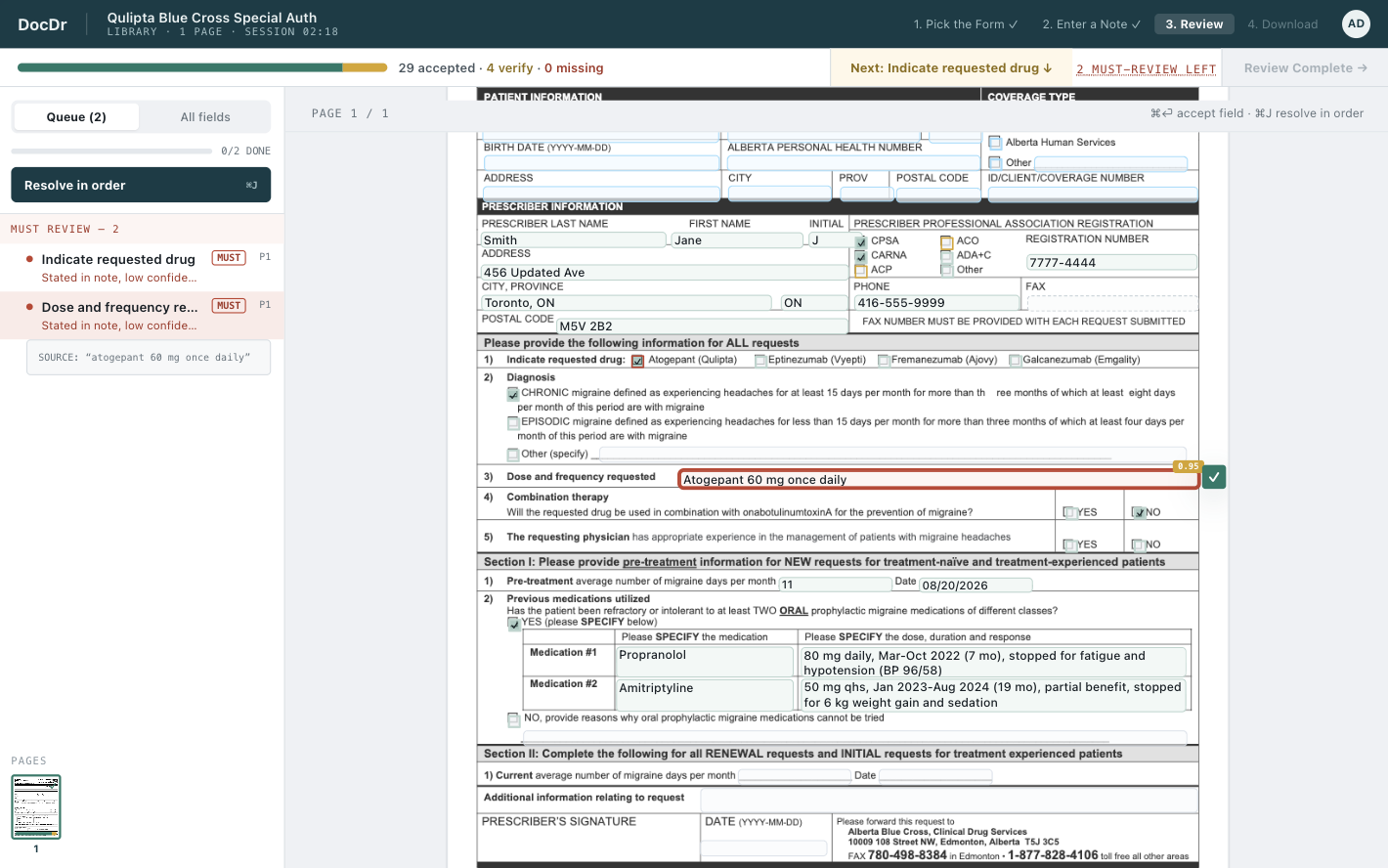
Each drafted value shows the exact passage of your notes it rests on, checked against the source when the form is drafted.
For Alberta clinicians
DocDr reads the notes you already have and drafts disability reports, insurer forms and drug authorizations. Every answer shows the exact passage it came from, so you review by reading, not by starting over.
AISH medical reports, CPP Disability applications, insurer disability claims, special authorizations and drug enrolment forms ask the same questions in different shapes. The answers are already in the chart, spread across your notes, consult letters and allied health reports gathered over months. Finding them, reconciling them and transcribing them is the work. DocDr does the finding and the first draft; you keep the judgement.
Source: Canadian Medical Association, administrative burden facts, drawing on CMA and Canadian Federation of Independent Business research.
Pick it from the curated library or upload the PDF or Word form you were sent.
Paste documentation from any source: your EMR, a scribe, consult letters, allied health reports.
Each answer sits on the form with its supporting quote. Fields that need your eyes are flagged first.
Get the original form, filled in place, ready for your signature and submission.
A draft is only useful if checking it is faster than writing it. Everything in DocDr is designed around that.
Each drafted value shows the exact passage of your notes it rests on, checked against the source when the form is drafted.
Two confidence scores per field, one for reading the form and one for filling it, combine into a review priority so you know where to look.
When the notes don't support an answer, DocDr leaves it blank. Conflicting, weakly supported or unverifiable values stop the form until you review them.
Library forms carry guidance written by a physician who completes them: which sections apply and how each program reads its questions. Alberta forms first.
DocDr needs only the form and the notes. No EMR integration project, and no dependence on which scribe, if any, you use.
Output is the original PDF with its own fields filled, not a retyped copy. Scanned forms get text placed on the page.
DocDr is preparing a pilot in Alberta primary care. It was built by a practising physician who completes these forms every week, and it is designed to be hosted inside health system infrastructure rather than only as a vendor subscription.
We welcome conversations with clinics, primary care networks, health system teams and funders interested in reducing form burden for clinicians and delays for patients.

From the founder
I'm a neurologist in Alberta, and before medicine I was a software engineer.
Every week, I'm filling out disability reports, special authorizations, and drug enrolment forms for my patients. The information is almost always already in the chart, or even right there in my own note. The work is finding it, reconciling it, and copying it into the right box, usually after clinic, when I should already be home with my family. Over time, it became the part of the week I dreaded most.
So I built DocDr to do that first pass the way I'd want it done: read everything, fill in what the notes support, leave a field blank rather than guess, cite the source for every answer, and hand the form back to the physician to review and sign.
A delayed form is a delayed treatment or a delayed paycheque. I've watched patients wait on that delay enough times to know what it costs them.
Dr. Chris HahnB.Eng, MD, FRCPC · Founder
Tell us a little about your practice and the forms you complete most. We'll be in touch about the pilot.